Showing posts with label missives from academia. Show all posts

7/24/2009

A Cultural Symbol Passes from the Scene: Ji Xianlin, Not Michael Jackson


By Timothy B. Weston

It’s been moving to watch the response in China to the July 11 death of renowned scholar, Ji Xianlin (1911-2009). While Ji’s unsurprising departure at the ripe old age of 98 has not brought quite the same flood tide of emotion and cultural stock taking in China as Michael Jackson’s completely unexpected death a few weeks earlier at age 50 has in the United States and around the world, the way the venerable scholar is being remembered in Beijing is nevertheless remarkable. Long lines of people wishing to pay their last respects waited for hours to gain entrance to a memorial ceremony held on the Beijing University campus where Ji taught, the press was full of tributes, and Communist Party leaders were very public in the honors they paid to the man from academe. In the United States it is hard to imagine the death of an elderly scholar, of a humanist who worked on the ancient past no less, ever attracting anything approaching the level of attention that Ji’s passing has in China.


Ji Xianlin and Michael Jackson shared nothing in common except the coincidence of the timing of their deaths and the fact that in passing both were mourned as departed cultural symbols. Frankly, as the hysteria over Michael Jackson’s death has continued to pulsate through American society I have found it refreshing to follow the treatment that Ji Xianlin’s high-minded life has received in China. I feel this way even though it’s clear that the Chinese Communist Party’s highly public paeans to the deceased scholar have not been free of political considerations and while also acknowledging that Michael Jackson’s life and career certainly merit serious reflection and social commentary. Still, when looking at the way Ji’s death has been treated as compared with Jackson’s, and at what the two cultural symbols meant to their times and places, I find myself more drawn to the values and maturity on display in China than to the self-referential, entertainer-obsessed conversation that Jackson’s death has occasioned in the United States (even if much of that conversation has been about the sadness and oddity of Jackson’s life).

Ji Xianlin was without doubt an outstanding scholar whose career was noteworthy for its singular achievements and cosmopolitan dimensions. Originally a student of Western literature at Qinghua University, in 1935 Ji traveled to Germany for foreign study. At the University of Göttingen he moved in a dramatically new direction, choosing to major in Sanskrit and other ancient Indian languages under the direction of Ernst Waldschmidt and Emil Sieg. Ji received his Ph.D. in Germany and after World War II returned to China where he took a position at Beijing University and founded the Department of Eastern Languages. He chaired that department for the next three decades and built it into one of the most important academic departments at Beida and China’s premier center for the study of Eastern languages.

Ji’s greatest scholarly accomplishments came in the realm of the history of Indian Buddhism and comparative linguistics. According to his former student Zhang Baosheng, now a professor in the Department of Foreign Languages at Beijing University, Ji’s academic achievements represented the next wave of greatness within the long, proud tradition of Chinese evidential scholarship after the great contribution made by Ji’s patron, the celebrated historian Chen Yinke, who helped bring Ji to Beida in the first place. Whereas Chen Yinke used literary works as a means of verifying history, Ji Xianlin pioneered a method of using comparative linguistics to verify historical events and to track changes over time. Ji’s scholarly findings attracted international attention and made him a world leader in his field; over the course of his career he was awarded major academic prizes in India, Iran and Japan.

In addition to pioneering new methodologies and creating new knowledge, Ji Xianlin also held important administrative positions in the later part of his life. Following the Cultural Revolution he was called upon to help re-build major Chinese academic institutions ravaged over the previous decade. In 1978 he became vice president of Beijing University (which position he held until 1984) and also director of the Chinese Academy of Social Sciences’ South Asia Research Institute. During his career he also served as chairman of various professional organizations, such as the Chinese Foreign Literature Association, the Chinese South Asian Association, and the Chinese Language Society.


Ji Xianlin’s achievements within academe distinguish him as one of the towering humanistic scholars of the Chinese twentieth century, as an intellectual whose name deserves to be mentioned, as it was again in a tribute piece recently published in Beijing, along with luminaries such as Chen Duxiu, Chen Yinke, Hu Shi, Li Dazhao, Liang Qichao, Lu Xun, Wang Guowei, and Zhao Yuanren. But Ji’s career, centered as it was in the esoteric academic field of Indology, which few people understand or appreciate, cannot account for the long lines of people wishing to pay their last respects at Beijing University nor for the tributes that poured in from highly placed people within the academic, publishing and cultural spheres upon news of his death. Likewise, Ji’s scholarly accomplishments and official positions at key academic institutions do not explain why the Chinese press has carried so much discussion of the scholar’s life, why Communist Party leaders Hu Jintao, Jiang Zemin, Wu Bangguo and Xi Jinping sent flower wreathes and offered condolences upon news of his death, or finally why, on July 19, his corpse draped in the red flag of the People’s Republic (Ji joined the party in 1956) and laid out for a final viewing, other top officials, including Wen Jiabao, Jia Qinglin, Li Chanchun, and Li Keqiang, showed up to make their farewells in person.


To understand why Ji Xianlin’s passing has struck such a chord it is necessary, I believe, to recognize that in his later years he had become a living symbol of the ideal Chinese scholar, and as such of a type of person who it is ever more difficult to find in today’s fast-paced, money-crazed Chinese society. Here was a man who had been born and raised in the old society, who knew the classics, who had attainted great fame and yet who did not attempt to convert his glory into power, wealth, or celebrity, who in fact talked down his achievements and continued to work hard at his research as long as he was able. Ji was not first and foremost a Confucian philosopher but he nevertheless came to be seen as a kind of secular Confucian sage who personified the committed life of the scholar. His integrity and wisdom, then, not his outstanding scholarly achievements, led to his being recognized as a “national treasure” (国宝), though he himself rejected such a label.

While the world around him buzzed first with Maoist revolutionary fervor and then with Western-style modernization, Ji Xianlin, identified with the secluded garden campus that is Beijing University, remained committed to his study of the ancient, non-Western past. He devoted his life not to the practical but to historical discovery, and in so doing was adamant in claiming that civilizational values other than those associated with the modern West deserve to be known, celebrated, and even selectively embraced as humanity collectively makes its way forward in time. The steadiness of conviction that informed Ji Xianlin’s life, and the messages he derived from his life’s work, proved highly reassuring during a period of unceasing and disorienting change.

In his humility and seriousness of purpose it is hard to imagine a greater contrast to Michael Jackson, the fallen American cultural symbol. Whereas Jackson forever reinvented himself and never ceased turning his life into spectacle, Ji occupied a well-established scholarly role with grace and distinction. Jackson was all artifice, Ji not the least bit affected. Jackson appears never to have known who he was, Ji to have possessed a remarkable inner compass and knowledge of self. The scholar lived simply, dressed in the clothes of a common worker, and was available, kind and respectful to one and all, regardless of social station. As those themes come up again and again in the articles that appeared after Ji Xianlin’s death I sense in them a nostalgia for the ideal of a life defined by the quest for pure knowledge and self improvement, for an age when those ideals were aspired to by society’s best and brightest.

For Chinese intellectuals Ji Xianlin meant more still. To them he was a hero who used (and so risked) his reputation to speak out on issues of concern to all. Like most of his colleagues, Ji suffered during the Cultural Revolution. Nevertheless, during that period he secretly worked to produce a brilliant Chinese-language translation of the Ramayana from the original Sanskrit, an act of bravery and scholarly devotion for which he later became celebrated. When after the Cultural Revolution he was named to high administrative posts at Beijing University and the Chinese Academy of Social Sciences he became one of the great survivors of the age and a symbol of the indomitable spirit of truth-seeking Chinese intellectuals.


In the mid-1980s Ji Xianlin added to that reputation when he published an essay calling for a new and more favorable appraisal of Hu Shi, who of course had been vilified during the Cultural Revolution. Ji’s point was that whatever Hu’s political mistakes, his contributions to the study of Chinese literature stood on their own and needed to be recognized. Not everything should be politicized, Ji maintained, a message that was widely praised within Chinese intellectual circles at the time. In the late 1990s, with the publication of his widely read and highly acclaimed account of his own experience during the Cultural Revolution, Memoirs from the Cowshed (牛棚杂亿), Ji’s reputation for speaking the truth in a courageous and thoughtful manner was deepened still further.

While it is impossible to know with certainty, it would seem that the Communist Party lavished so much praise on Ji Xianlin upon his death not only because many of its top leaders recognized his scholarly achievements and admired him personally (Wen Jiabao is even said to have referred to Ji as his mentor) but also because in embracing him and what he stood for they were able to communicate to Chinese intellectuals on the eve of the all-important Sixtieth Anniversary of the founding of the People’s Republic of China that they share heroes in common, that they speak a common language. Unlike American political leaders, most of whom do not feel compelled to demonstrate any cultural competency whatsoever, top political leaders in China desire to be taken seriously by intellectuals and to display to the public at large that they are not only working to protect and strengthen the country but also that they prize the scholarly custodians of the Chinese past. Culture, history and politics are intertwined. So to bind Ji Xianlin to the political leadership in a clear way, the party press went out of its way to identify Ji as a great Chinese patriot, as a figure who dedicated his life to his people and to his country’s improvement. In these ways it was useful for the Communist Party and its official media organs to mark Ji’s passing and to extol his virtues.

Finally, Ji Xianlin happened to pass at the very moment when the sad and murderous recent ethnic violence in Xinjiang was filling the media in China and around the world. As the fractiousness of contemporary Chinese society, at least one part of it, was on display and impossible to deny (even if its causes will long be debated), and as Party leaders scrambled to contain the damage, an orderly period of mourning for a great man, a great Communist with popular appeal, was an attractive possibility.

And here Ji Xianlin’s worldview and unique scholarly contributions proved particularly meaningful, for one of the things that Ji stood for most powerfully was the idea that, to quote Ji himself: “Cultural exchange is the main driv[ing force] for humankind's progress. Only by learning from each other's strong points to make up for shortcomings can people constantly progress, the ultimate target of which is to achieve a kind of Great Harmony.” Not only should the Chinese people admire Ji Xianlin for his great scholarly achievements and his integrity, the official obituaries seemed to suggest, they should also realize that he stood for cultural tolerance, for the idea that only by accepting and interacting with one another can all people (the nation) prosper. Harmony as the goal—something Hu Jintao and Ji Xianlin, the great sage, could agree on.

Timothy Weston teaches in the department of history at the University of Colorado, Boulder. He is a participant in the National Committee on US-China Relations' Public Intellectuals Program and author of The Power of Position: Beijing University, Intellectuals, and Chinese Political Culture, 1898-1929 (UC Press, 2004).

All photos from Xinhua: 1, 2, 3, 4, 5

7/23/2009

Confucianism in Chinese Academia


By Daniel A. Bell

Over the last decade or so, there has been a revival of Confucianism. Popular books on Confucianism are best sellers, and official discourse from the government often expresses traditional Confucian values like harmony. What is less well known, however, is the resurgence in interest among academics in China.

Rigorous experiments by psychologists such as Peng Kaiping and Wu Shali show that there are striking cognitive differences between Chinese and Americans, with Chinese more likely to use contextual and dialectical approaches to solving problems. Psychologists Huang Guangguo and Yang Zhongfang from Taiwan and Hongkong advocate the use of traditional Chinese ideas like the “relationism” (guanxizhuyi) and “middle way” [zhongyong zhi dao] for psychological research. Economists such as Shen Hong take the family as the relevant unit of economic analysis and try to measure the economic effect of such values as filial piety. Feminists such as Chan Sin Yee and Li Chengyang compare care ethics and Confucian-style empathy, particularity, and the family as a school of moral education. Theorists of medical ethics such as Fan Ruiping discuss the importance of family-based decision making in medical settings. Those working in the field of business ethics like Huang Weidong research the influence of Confucian values on business practices in China.

Political surveys by political scientists like Shi Tianjian, Chu Yunhan and Zhang Youzong show that attachment to Confucian values has increased during the same period that China has modernized. Sociologists such as Kang Xiaoguang and Sebastien Billioud study the thousands of experiments in education and social living in China that are inspired by Confucian values.

Theorists of international relations such as Yan Xuetong and Xu Jin look to pre-Qin thinkers like Mengzi and Xunzi for foreign policy ideas. And philosophers such as Jiang Qing, Chen Lai, Bai Tongdong, and Chen Ming, draw upon the ideas of great Confucian thinkers of the past for thinking about social and political reform in China. Wang Richang discusses the Confucian foundations of government slogans like “yi ren wei ben” (“the people as the foundation”)

But academics doing research on Confucianism often work within rigid disciplinary boundaries borrowed from Western academia. At a recent conference, "Traditional Values in a Modern Chinese Context: An Interdisciplinary Approach," which was held at China’s Renmin University in Beijing this June, we tried to break away from this pattern. Leading academics working on Confucian values from different disciplines met to see what they could learn from each other. The conference, which was convened by Shi Tianjian, Kang Xiaoguang, Peng Kaiping, and myself, was supported by the Carnegie Endowment for International Peace, and organized by the Non-Profit-Research Center, Renmin University.

Chen Lai pointed to the complexity of measuring Confucian values, which would involve tracing their origin in classic texts, their historical development, as well as evidence of contemporary influence. But most participants still felt that the research was well worth doing, given the importance of Confucianism for understanding Chinese society and furthering social and political reform rooted in local conditions.

As one might expect, there were important areas of disagreement. For one thing, the starting points were often different. The majority sympathized with Confucian values and openly admitted that they begin with normative standpoints, just as liberal thinkers try to promote liberal values. Some claimed that they are doing purely scientific work measuring Confucian values. And some do both: most notably, Kang Xiaoguang both promotes political Confucianism and studies its development in Chinese society.

The participants also identified areas of study that could not be researched fruitfully from other perspectives. Philosophers like Jiang Qing pointed to values like tian and liangzhi that could not be studied by the empirically-minded social sciences, and Confucian educators like Yang Ruqin argued that moral growth is long term and could not be measured in controlled laboratory studies.

But the workshop also led to some fruitful proposals for cross-disciplinary research. The participants noted areas of weakness in their own disciplines that could be usefully addressed from other perspectives. Philosophers and historians could help to refine the questions posed in political attitude surveys. For example, the “Confucian” attitude measured by political scientists that children should blindly obey their parents should be made more conditional if the aim is to measure attachment to Confucian values rooted in classic texts. Philosophers might also suggest questions for research inspired by less well-known Confucian values, such as the idea that listening to different types of music or believing in different views of human nature (性善vs性恶) have different moral consequences during the course of one’s life.

Social scientists, for their part, can help philosophers determine which Confucian values are most effective in contemporary society. For example, the claims that filial piety provides the psychological basis for extending morality to non-family members could be researched by means of longitudinal studies. Psychologists could also identify the key ages that best allow for the memorization of classical texts. Social scientists could also help to study whether morality normally improves with age and whether learning the Confucian classics really does make rulers more morally sensitive and politically effective.

The findings of social scientists might also help Confucian philosophers to determine which Confucian values are particular to societies with a Confucian heritage and which ones might be universalized. For example, the finding that collectivist attitudes are more typical of Chinese subjects in experimental settings means that there will likely be resistance to promoting those values abroad (just as there would be resistance to promoting highly adversarial and interest-based politics in China). Yan Xuetong pointed out that Confucianism won’t be taken seriously abroad unless it is practiced by political leaders at home.

These research questions remain open. What is clear, however, is that academics need the freedom to discuss and publish their ideas and adequate funding to carry out research in order to pursue these questions in fruitful ways. Under the right conditions, China could well develop into a leading center of global learning, with academics researching questions and values hitherto neglected in the West.

Daniel A. Bell is a professor in the Department of Philosophy of Tsinghua University. His latest book is China’s New Confucianism: Politics and Everyday Life in a Changing Society (Princeton University Press, 2008).

5/14/2009

Journal of Asian Studies 68.2


In the brand new May 2009 issue, just up on the Cambridge University Press website, readers will find, free for now at least, two relatively short (four to six-thousand words) pieces in the Journal of Asian Studies' new "Asia Beyond the Headlines" series--one by Berkeley economist Pranab Bardhan is on China-India comparisons, while the other is a take by USC political scientist Stanley Rosen (who took part in the Brookings Institution panel that was the subject of a recent post by Teresa Wright) on youth and politics in China.

The third piece is a full-length one (with illustrations) on Confucian temples by University of Wisconsin art historian Julia Murray (a contributor to China in 2008) who deals with the past and also the present (the cover of the issue shows an image from her illustrated piece). Here's the link (once there, each is a click away to read in HTML or as PDFs).


5/10/2009

Academic Journal Report: Inter-Asia Cultural Studies by Nicole Barnes


I have in my hot little hand the December 2008 issue (Volume 9, Number 4) of a hot little journal from Routledge Press, Inter-Asia Cultural Studies. Supported by the Chiang Ching-Kuo Foundation and Taiwan’s National Chiao Tung and Tsing Hua Universities, this journal has a truly international editorial collective hailing from Singapore, Sri Lanka, the Philippines, Bangladesh, Indonesia, Taiwan, the PRC (including Hong Kong), Japan, Australia, Malaysia, Thailand, Korea, India, and the U.S. To further demonstrate its comprehensive Pacific Rim approach, the journal accepts publications in Asian languages as well as in English.

Although this is an academic journal, it addresses contemporary issues that all China Beat readers could enjoy. Volume 9 Number 2 was a special issue dedicated to Taiwanese filmmaker Hou Hsiao-Hsien. Each issue also includes a “visual essay” focusing on analysis of visual culture.

The December 2008 special issue on Urban Imaginaries features seven articles on specific features of urbanity in Hong Kong (which garnered 2 articles), Tokyo, Shanghai, Sydney, San Francisco, and Beijing. Law Wing-sang explains the popularity of police-gangster movies in Hong Kong cinema (as best exemplified by the wildly popular Infernal Affairs series) by linking them to Hong Kong’s dirty past of “collaborative colonialism” in which British succeeded in subduing the colony only with Chinese help. Koichi Iwabuchi also uses film—specifically, the movie “Lost in Translation”—as a focal point for a discussion of Tokyo’s own modernity being “lost in translation” as other cities leave the once über-modern Japanese capital in the dust.

Yaming Bao explores white-collar consumer culture in contemporary Shanghai through an examination of the “Xin Tiandi” (新天地 “New Space”) shops, the Kodak company’s “Kodak Super Cinema World”, and the weekly entertainment magazine 上海一周 (Shanghai Weekly). John Nguyet Erni interviewed 50 people in Hong Kong to investigate the “social and political after-shock” of SARS. Graeme Turner’s article juxtaposing urban and suburban Australia calls to mind UCI’s own Mark Levine’s work on Tel Aviv and Jaffa (see the Journal of World History). It seems that cities around the world claim modernity by distinguishing themselves from their suburbs and neighboring cities.

This issue’s visual essay, an interrogation of Chinese modernity and state-sanctioned violence as expressed in twentieth-century gardens in Beijing is by none other than Geremie Barmé, a prolific China scholar whose name often crops up in China Beat posts.

Lastly, I must say that Inter-Asia Cultural Studies is very sleek. It is attractively thin (not at all intimidating), includes Asian text rather than mere romanization, and has high-quality paper for sharp images. It is well worth checking out.

5/01/2009

Intellectuals and the Nation in China and India: A roundtable report


Last Friday, China Beat and the UCI International Center for Writing and Translation (ICWT<) hosted a public roundtable with UC Riverside professor Perry Link and Tiananmen activist Wang Chaohua weighing in on the China side, and writer Pankaj Mishra (a frequent friend of the China Beat) and UCI professor Vinayak Chaturvedi speaking about India. China Beat and UCI’s Jeff Wasserstrom moderated the roundtable discussion, and asked the panelists to consider “dates ending in 9” of specific relevance for China (1919, 1949, 1959, 1979, and 1989) and India (where 9-2 seems to be a more pertinent number, as in 1857 and 1947).

Vinayak Chaturvedi began with a discussion of 1909 as the year of publication of 2 foundational texts in Indian nationalism: Gandhi’s Hind Swaraj (or Indian Home Rule) and Vinayak Damodar Savarkar’s Indian War of Independence: 1857, a history of the 1857 “mutiny” (if you were British) and “war of independence” (if you were Indian). [Readers who are intrigued by the reflections of one Vinayak, a UCI professor, on another Vinayak, a Hindu nationalist, can read Dr. Chaturvedi’s article on the same subject in Social History vol. 28 no. 2 (May 2003).] Gandhi’s text and work laid the foundations for the heterogeneous nationalism of a multi-ethnic state as carried forth in the Congress Party, and Savarkar’s text laid the foundations for a militant Hindu nationalism that excludes Muslims and a long list of others, as seen in today’s Bharatiya Janata Party (BJP). The two parties and two versions of Indian nationalism have long contested one another, but in the meantime neither has fulfilled its promises to the Indian people.

In addition to being a long-term activist, Wang Chaohua is also an academic with research interests in the May Fourth movement of 1919, and editor of the pre-eminent collection of contemporary Chinese intellectuals’ essays, One China, Many Paths. She argued that the best way to understand Tiananmen in 1989 is to compare it with 1919. In both periods the Chinese government was rather disoriented and fairly weak, and activists used similar methods of organizing themselves. The most important common feature is that in both movements, activists allied across class and occupation to create a broader social movement of students, laborers, and white-collar urban workers. Unfortunately, Dr. Wang ended on a sad note. Many people ask her about the prospects of greater freedom for mainland Chinese, but she feels that the current University students in China are even more urban and bourgeois than before so they are less likely to create such a broad-based movement.

Perry Link noted that he was in Beijing in 1989 and attended two events commemorating the 70th anniversary of the May Fourth movement. Government officials in Beijing hosted a grand event in which they labeled the movement as the foundation of Chinese nationalism, the moment when the Chinese people stood up to imperial powers, and the lead-in to the founding of the Chinese Communist Party. Meanwhile, down the road a ways, Qinghua and Beijing University professors hosted a commemoration in which they spoke of the movement as a time of opening the halls of learning to people of both genders and all classes, and of deepening public conversations about science and democracy. Since the 90th anniversary is just around the corner, we might be on the look-out for a similar split in commemorations.

Pankaj Mishra spoke of the current “9” year—2009—as a moment of geopolitical crisis for India. Many conversations of India being the 21st century superpower with the help of the U.S. had long overlooked India’s “big neighbor to the north,” but after the 2008 Beijing Olympics it has become evident that not only can China no longer be ignored, but she might in fact inherit the superpower crown. At the same time, the financial crisis is hitting India hard, and Obama has made it clear that his intentions are to use India as a political counterweight to Afghanistan and Pakistan, not to China.

The conversation touched upon many more scintillating issues, but the report shall end here for sake of a pretense of brevity.

4/03/2009

Commemoration in 2009


Readers may be interested to know that the new issue of China Heritage Quarterly is out, and it examines the issue of commemoration (a relevant issue at the moment as, having just passed one sensitive set of dates, we are now into the spring--months strewn with anniversaries). As Editor Geremie Barmé writes in the March issue's editorial:

The year 2009 also marks other significant anniversaries. Some of these will be commemorated with due pomp and circumstance in the official media and dissected at length by learned gatherings. Others—those events best thought of as 'dark anniversaries'—will pass by in an atmosphere of heightened alertness, security crackdowns and official anxiety. These dark anniversaries are the silent markers of quelled protests, social unrest and state violence: events like those of 1959 in Lhasa, the closing down of the Xidan Democracy Wall in 1979, the tragedy of 1989 and the religious repression of 1999. They all offer other stories, and a contentious heritage, that play their own role in the unsteady growth of the strong unitary modern state...These years and the days within them offer a penumbra of history; they stand in shaded contrast to the vaunted moments of commemoration, those anniversaries which bask in the merciless glare of publicity and enjoy official largesse. Although formally ignored, or recalled only in verso, dark anniversaries cast a gloomy shadow over the orchestrated son et lumière of state occasions. The Doppelgängers of these dead anniversaries haunt the living.
Articles featured in the issue include a translation of a commemorative essay for the May Fourth anniversary by Xu Jilin (that will also appear in Dushu). A careful recounting of the intellectual issues and causes of May Fourth activists, this paragraph stands out:

By the end of the twentieth century, as a result of the severe damage caused by revolutionary utopias, Chinese thinking people readily reflected on and critiqued utopian ideas. And yet we recognised that although the proximate source of such revolutionary utopias were the forms of May Fourth idealism and romanticist longings, it was clear that which later degenerated into that cruel and merciless 'dictatorship of the proletariat' could not be mentioned in the same breath as the cosmopolitan utopia of the May Fourth era. This cosmopolitan utopia was totally opposed to the blood and iron principles of the politics of power and transcended the narrow aims of nationalism. It had embodied global values that are the common quest of all races, all nations, and all peoples. The 'Eternal World Peace' envisaged at the time by Kant was also a form of cosmopolitan utopia, inspiring the greatest political philosopher of the twentieth century, John Rawls, to argue for his 'realistic utopia' in The Laws of the People as a way of achieving global justice. With the rise of nationalism and statism in the modern period, human society required a cosmopolitan utopia to manage global justice, to constrain the tensions and clashes that result from the overdevelopment of statism. Utopian ideals present a global sense of values that are universal and provide the common stipulations for the existence and development of human society. How remarkable was the broad-mindedness of those May Fourth intellectuals, possessed as they were of that brand of cosmopolitan longing, never for a moment seeing the interests of a particular nation or nationality as a gulf to be crossed, seeking always for that 'nation committed to cosmopolitanism', basing the rise of a particular nationality solidly on global human values. This was the patriotic movement of the May Fourth, a patriotism that was possessed of cosmopolitan ideals.
Other selections in the issue include essays by Barmé as well as additional translations and literary analysis. The site also hosts the journal's archives, for those interested in further browsing.

3/28/2009

Blogging AAS


From Paul Katz (3/28/09, 2:27 p.m.):

Saturday morning was a disaster, or at least full of fascinating panels about disaster and resulting relief efforts. Panel #139, alluded to by Kate Edgerton-Tarpley in her earlier post, explored the sociocultural impacts of the Great Leap Famine. Relevant research has also been done by Steve A. Smith in his "Talking Toads and Chinless Ghosts" article, published in The American Historical Review in 2006, and he has also written on this topic for the China Beat. There was also Panel #167, organized largely by a group of German scholars, which builds on the pioneering work of scholars like Kate, Pierre Etienne-Will, Fuma Susumu 夫馬進, Joanna Handlin-Smith (whose book is at last out!), and Angela Leung (梁其姿) in examining philanthropic responses to natural disasters. It would also be interesting to learn more about the extent to which such activities were inspired by religious beliefs, not to mention organized by religious associations.

In addition to disasters, there was also extensive border crossing, this time in the world of art. This could be seen in two panels (#126 and #149) that focused on the international dimensions of Asian art, including its links to cultural nationalism.

Finally, a word about the book exhibit: One cannot help but be amazed at the number of high-quality studies of Chinese religions now being published by Harvard University Press, including works by Vincent Goossaert, C. Julia Huang, David Johnson, Liu Xun, Rebecca Nedostup, James Robson, and Jeffrey Snyder-Reinke. HUP is clearly joining the ranks of other prestigious presses that continue to contribute to the growth of this field, including California, Leiden, Hawaii, and Stanford.


Pictures from Jeff Wasserstrom (3/28/09, 3:52 p.m.):

The Second Annual Blogger's Breakfast

L to R: Par Cassel (who blogged about the term "Tiananmen" in June 2008), Benjamin Read (featured in a CB interview on homeowners), Paul Katz (Taiwan, Taiwan, Taiwan--and Chinese religion), Susan McEachern (the Rowman & Littlefield editor who made China in 2008 happen), Julia Murray (who hasn't blogged for us but is in the book with a piece on the revival of Confucianism), and Shakhar Rahav (who wrote about how the Olympics were covered in Israel for CB). Haiyan Lee is not shown, due to the limitations of the photographer...


China Beatnik Goes from Writing about Prizes to Winning One

Speaking of Haiyan Lee, whose last piece for CB was about a book prize, won her own prize last night. Lee was awarded the Levenson Prize for 20th Century China (there's also one for pre-20th century topics).


Don't Judge a Book by Its Cover (But Cool Cover...)

Here is Paul Cohen, who was featured in a CB interview, posing beside a display for his book. Like many authors, he doesn't want his book to be judged by its cover, but there's widespread buzz here that it is wonderful cover indeed (the cover of another book we've talked about on the site, Susan Mann's Talented Women, shows up in the photo as well).

AAS Blogging


Jeff Wasserstrom (3/28/09, 7:41 a.m.):

This is, of course, the first AAS meeting at which a book associated with the China Beat has been displayed. And nicely displayed it definitely is, as the accompanying photo illustrates (and note that it is shown in the company of books like Voices Carry, China Ink and The Subject of Gender, which have been discussed on our site before).

More than that, though, this is also a conference that, overall, has some features that run in tandem with some of the goals of China Beat. For example, just as we've tried to encourage more interchange between academics and other kinds of writers, there have been some sessions here that, thanks to generous support from the Luce Foundation, have already included or will include reporters and freelance writers. China Beat contributor Lijia Zhang (shown below posing with a poster for her memoir) and Ching-Ching Ni of the Los Angeles Times (shown below sharing her thoughts on the challenges of covering Chinese topics in the field), for example, were both part of a lively session on the Olympics, during which they shared the stage with Beijing-based specialist in Olympic studies Jin Yuanpu (shown below giving his presentation in Chinese), Susan Brownell (who did double duty as both moderator and Jin's translator), and Korea specialist Bruce Cumings (who gave a very smart summary of all the problems with thinking of the Seoul Games as a major contributing force in South Korea's democratization).
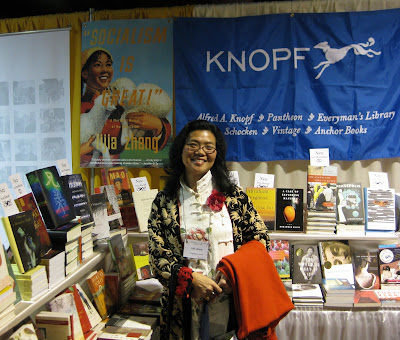
Lijia Zhang

Ching-ching Ni

Jin Yuanpu and Susan Brownell

Conference Report: Asia and the Environment


By Maura Elizabeth Cunningham

I began reading Pallavi Aiyar’s Smoke and Mirrors on my flight to Philadelphia last week to get me into a China-India frame of mind before I attended the “Asia and the Environment” conference held at Saint Joseph’s University on March 20-21. Although Friday’s sessions (which I unfortunately missed) were devoted to India, and Saturday’s topic was China, the goal of the conference organizers was to encourage some comparative discussion of the environmental problems—and possible solutions—shared by the two countries. Readers interested in specific presentations should watch the above SJU website, where podcasts of the talks will be available in the future; for now, I’ll share a few of the most frequently recurring themes from Saturday’s events.

As Ken Pomeranz pointed out in “China’s Water Woes” (Feb. 12, 2009, China Beat), China and India are inextricably bound by their shared water resources. Since China controls the headwaters of many of Asia’s major rivers, this gives Beijing a tremendous amount of control over the fates of various populations living beyond Chinese borders. Pollution, of course, doesn’t stop at national boundaries, and dams built in China have major effects on downstream communities. Given the increasing scarcity of unpolluted water in Asia, the potential for international conflict over river resources seems to be heightening with each new dam project or toxic spill.

To put a more positive spin on this situation, however, several conference-goers emphasized that dependence on shared resources also provides China, India, and other Asian countries new opportunities for negotiation and cooperation. How much optimism is warranted? Perhaps not as much as I have, but the transboundary nature of environmental issues does seem to offer an ideal platform for countries to develop good working relationships with each other. State officials simply cannot afford to ignore the necessity of collaborating with leaders in other countries; it is in their best interests to unite together as they attack environmental problems.

As one panelist at the concluding round table discussion noted, “We can talk about Asia as a whole through the environment,” and it would seem natural for China and India to take the lead in promoting environmental protection throughout the continent. Although a fair number of ominous-sounding facts and figures were mentioned by different speakers as they related the terrifying extent of Asia’s environmental troubles, the final message that I took away from my day at the conference was the importance of looking beyond the problems and thinking more about what’s being done right, and seeing the creative solutions taking hold in response to various crises.

State leaders, NGOs, and private corporations throughout Asia are already stepping in to address environmental issues, and will hopefully make enough progress to prevent any sort of catastrophic event in the future. The next major step that needs to be taken is for those organizations to recognize how essential international cooperation is for environmental protection measures to work. China alone is not "Choking on Growth"; the country shares its problems—and, with luck, successes—with every one of its neighbors.

3/27/2009

From the AAS


From Kate Edgerton-Tarpley (3/27/09, 4:03 p.m.):

Attending Panel 44, "Visualizing Order: Images and the Construction of Legal Culture in Ming and Qing China" inspired me to continue Paul Katz's discussion of religion -- as well as law and ritual -- for a moment. Both Katz's paper on representations of underworld justice in late imperial China and Yanhong Wu's paper on legal order in Ming case stories and illustrations provided fascinating examples of ghosts, spirits, birds, and leaves entering courtrooms to either exonerate an innocent person or condemn a guilty one. Katz argued that Underworld justice was seen as less corrupt than the law system for the living, so women and others who had trouble getting justice often turned to it. The discussant, Edward Farmer, then made the point that there was a need for this alternative justice system because imposing and upholding hierarchy, rather than bringing about justice, was the main concern of the official legal system. I thought, however, that some of the examples offered in the papers, both Yanhong's and Thomas Buoye's, did show a real concern with justice in the official courts. Perhaps the degree of concern for justice in official courts could be a topic for future discussion.

Panel 44, as well as comments made by Keith Knapp during his presentation on "Magistrates and Miracles" in panel 118 on "The Mandate of Heaven at the Local Level in Imperial China," both highlighted the need to acknowledge how real, important, and powerful the religious aspects of Confucianism (not to mention Daoism and Buddhism) were for official as well as everyday life in imperial China. These panels demonstrated a fascinating degree of interplay or, as Katz termed it - a continuum between official duties and religious duties, between official courts and underworld courts, between human plaintiffs and ghost/spirit plaintiffs, between the human and the supernatural.

In the Great Leap Famine panel tomorrow morning (#139), I plan to touch upon the impact -- in terms of official responses to famine -- that the loss of the Mandate of Heaven idea and religious constructions of famine and drought had in 1959-61.

Blogging the AAS


The Association for Asian Studies annual meeting is taking place this weekend in Chicago. We'll be posting occasional updates from China Beatniks who are attending the meeting and will be checking in about the sessions and meetings they've participated in. Below, our first two postings from the meeting.

From Jeff Wasserstrom (3/26/09, 11:53 a.m.):

As Editor of the Journal of Asian Studies, I needed to be on site a couple of days before the Association for Asian Studies panels and other main events begin, and I have been struck since arriving by how many things I've seen inside or near the Sheraton hotel (the conference base) that link up to Chinese events and locales, blogging, or things people whose China blogs I follow have addressed.  I've rolled thoughts and images relating to these into a pre-conference post.

Blog-Based Books Enter the Mainstream (of American publishing)
On the blogging front, this morning's edition of USA Today, provided free to all hotel guests, had a piece called "Books Editors Look to Bloggers for Possibilities," which caught my attention in part because this conference is the first at which China in 2008: A Year of Great Significance will be on sale. Like most American reports on the topic of blog-based books, it didn't mention the fact that such publications became more routine in China before doing so in the U.S. It also didn't give any examples (are there any out there?) of books that, like ours, is based on a group blog with many contributors, as opposed to, for example, solo ones by Colby Buzzell. The piece ends by wondering: "Can the Twitter novel be far behind?"

The Games after the Games after the Beijing Games
Here's a photo taken a block from the hotel, of a flag promoting Chicago's bid to host the 2016 Games. Surely, the backers of this bid are relieved for many reasons, including budgetary ones that, if they succeed, they will be following London's show as opposed to Beijing's.


Did They Know the Asian Studies Crowd Was Coming When This Statue Went Up?
Here are two photos of a massive piece of public art, playing upon a famous American painting. Its presence a few blocks from the hotel has nothing to do with the AAS meetings, but it is hard to imagine a more fitting statue to see when walking near a Midwestern conference with panels dealing with many of the cities and countries flagged on the suitcase.


Some Ties Grow Tighter, Others Loosen
If the statue suggests an increase in travel between Chicago and Asia (also signaled by the number of flights to Asian cities that leave from O'Hare airport), there's one kind of longstanding connection between here and there that a recent blog post by Evan Osnos reminds us have recently been severed. Namely, the Chicago Tribune (whose headquarters is right near the stature) closed its Beijing bureau (part of a general scaling back of reporters based abroad)--Osnos (who now works for The New Yorker) was the Windy City newspaper's final China correspondent. 

The Tribune's tradition of fine reporting from Asia will be represented at this conference, however, as Michael Lev, who used to be based there and now is Chicago-based, though still working for the paper, has graciously agreed to pinch-hit for a panelists who had to pull out at the last minute on a special roundtable devoted to "Asia and the Global Economic Downturn" that takes place on Saturday at 5 p.m. (with Nayan Chanda, Ted Fishman, and Ezra Vogel, the other participants). I'll be on a different panel at the same time, but maybe someone else will blog about that session, which covers a topic that could hardly be more timely. I hope so, as I'm eager to learn what transpires there.

From Paul Katz (3/26/09, 9:12 p.m.):

Just spent the first night of our Annual Meeting bopping between Sessions 16 & 17, both of which concerned the religious revival in China today. The papers by Sebastien Billioud (on Confucianism), as well as Gareth Fischer and Wu Keping (on lay Buddhism) were particularly striking in terms of demonstrating the intensity of popular participation in these movements, as well as its links to the formation of different types of individual and group identities. Their works suggests that religion in China today is actively addressing the concerns of its people, which in some ways seems related to ideas of modernity. At the same time, however, this also exhibits profound continuity, as religious movements have been dealing with the concerns of their worshippers throughout the ages.

Tomorrow will be a typically hectic AAS schedule, beginning bright and early at 8:30 with my paper on images of the judicial underworld, which will be presented in Session 44 ("Visualizing Order: Images and the Construction of Legal Culture in Ming and Qing China"). I also plan to attend two other Chinese religion panels: one on lay Buddhism in modern China (#93), the other on the Mandate of Heaven at the local level (#118).

3/24/2009

On Contemporary China

(In 75 minutes)

It's no small task to sum up the work of 53 separate authors but I gave it a go last Friday at the Virginia Festival of the Book when I spoke about China in 2008. I shared the stage (and live C-Span connection) with Susan Brownell (who gave a fascinating presentation on the Beijing Olympics and Olympic education in the Chinese schools) and our moderator, UVA professor of politics Brantly Womack. The session turned into a lively discussion with the audience of about 45 about how we can find ways to more accurately represent (and then hopefully understand) China in the U.S. Here's a quick list to give you a sense of some of the issues that the audience raised (and since I don't have access to the C-Span broadcast, I'm going to have to wing it from memory).

Action shot, before the panel started

1. Best question on the Chinese internet: "I thought China was a closed society. But you seem to be describing a different kind of media environment. Can you give some more examples of that?"
It's easy to forget, living in a little blog bubble, that not everyone is keeping up with the excitement and subterfuge of the Chinese internet. I referenced China's Censorship 2.0 by Rebecca MacKinnon as evidence of how patchwork internet censorship is in China. But this question is also a reminder that the media's emphasis on the "Great Firewall" has skewed general understanding of China's media environment as a blackout zone. 

2. Most complicated question: "The picture of China you are presenting doesn't seem much like what I read in the news. Why is that?"
This is a toughie. There is a lot of great reporting and writing on China, but unfortunately there's crummy stuff too. And in a world of soundbites it's easy for the story to be reduced to "China: Bad." As I reiterated at the panel, the most important thing is to try to understand China as it is, not as we expect it will be or as we hope it will be. And we should understand China as just as complicated and diverse (if not more so) than the U.S.--when you hear someone talking about "the Chinese believe this" or "the Chinese do that" it's a red flag that you're not getting the full story.

3. Most fun question to contemplate answers to: "I'm about to take a trip to China. What should I read?" 
This question was asked after the panel had ended and I recommended taking a gander through China Beat and several other blogs as well as (since the asker was headed to Beijing, among other places) Michael Meyer's Last Days of Old Beijing. Of course there are a lot of other options--I'm curious to hear what you all recommend to your China-bound friends, so feel free to leave comments to that effect.

4. Question I couldn't answer, but have since fished up a little info about: "How is China addressing disabilities like dyslexia?"
My immediate thought was, "Is is possible to be dyslexic when reading Chinese characters?" I clearly needed a little educating on this topic. The answer is: yes, but dyslexia rates are lower in China (and Japan) than in the U.S. Interestingly, recent studies have found that the neurological abnormalities that make English readers dyslexic are different from those that make Chinese readers dyslexic. Perhaps some readers have more information on how dyslexia is addressed in Chinese schools.

5. Questions I was expecting (but wasn't asked): What's up with China pestering our spy boats? How is the economic downturn affecting China? Why doesn't China want Coke to make their apple juice? 
I thought one of these questions might pop up. But this well-read crowd wanted to talk meta-questions--how China is represented in the media and why. In terms of events-related questions, though, I did get a follow-up about the winter 2008 ice storms, which some in the crowd did not remember. Brantly Womack jumped in with solid info, holding up his cup to show how thick the ice was on the powerlines and saying, "If this storm had happened here, we'd still be talking about it." It was a good example of how to bring the foreign home. 

L to R: Susan Brownell, Brantly Womack, Kate Merkel-Hess

3/22/2009

Coming Distractions: China Events at the 2009 AAS Meeting


USC's very useful US-China Institute website, which helps us keep up with relevant events taking place in Southern California and other places as well, has a helpful guide to the upcoming Association for Asian Studies meetings, which will be held in Chicago March 26-29. Even if you won't be anywhere close to Chicago on the relevant dates, scrolling through this list of China-related panels can be an effective form of one-stop shopping for those interested in getting a quick sense of the sorts of things that academics (mostly North American, but the meetings pull in participants from other parts of the world as well) are working on and talking about these days. Not everything of potential interest to readers of this blog is mentioned there (e.g., some that have a China plus other parts of Asia focus were skipped), so if you are going be sure to look at the main page for the meetings, which among other things calls attention to the organization's recent efforts to bring more policy-makers and journalists into the mix at AAS gatherings.

There are so many panels listed on the USC website that involve people who've blogged for us, people who've written things we've blogged about, people we'd someday like to have write for us, etc., that we're loath to single out any sessions for special attention. Still, we can't help mentioning one that includes participants not often seen (especially together) at conference held on this side of the Pacific. This is SESSION 70, which will take place from 10:45 A.M.–12:45 P.M. on the Friday of the meetings and bring together into a discussion on Chinese intellectual life, among others, Geremie Barmé (coming over from Canberra), Worrying about China author Gloria Davies (coming over from Melbourne), and former Dushu (Reading) editor Wang Hui (who is based in Beijing).

If any reader involved in another panel wants to draw special attention to it (and explain why readers of the blog might find it particularly interesting) by posting a comment--please do so. And there's another kind of comment we'd welcome. Namely, since many of us will be at the meetings (a good one for us to attend in part because the just-out CB-based anthology China in 2008: A Year of Great Significance will be displayed at the Rowman and Littlefield booth), we may well run one or more posts about the meetings, so if you can't be there and see something listed that you'd particularly like to learn about long distance after the fact from someone who caught it, feel free to post a comment about that as well.