Showing posts with label Self-Promotion Saturday. Show all posts

7/21/2009

China Beatniks Around the Web


After a few weeks of vacation, China Beat is back to posting (though we considered making an 8 percent reduction in our future posts in honor of the UC furlough, we’ll just be back to business as usual). Even so, it is still summer and a few contributors have been using the time to publish in other venues.

Last Saturday, Ken Pomeranz mentioned a few of his recent publications, including this one at the New Left Review.

Jeff Wasserstrom recently reviewed Lisa See’s new book, Shanghai Girls for Time Asia. (We ran an interview with See this spring, which you can read here.)

The new issue of Journal of Democracy also features a piece by Wasserstrom, “Middle-Class Mobilization,” which revisits some issues he’s written about for China Beat and The Nation. This issue also includes pieces from Yang Guobin (a China Beat contributor) as well as Elizabeth Perry and Andrew J. Nathan. Journal of Democracy makes a few articles from each issue free; this issue the free-access articles are “The Massacre’s Long Shadow” by Jean Philippe-Béja and “Authoritarian Impermanence” by Andrew J. Nathan. (The other essays can be accessed through Project Muse, for those with library access.)

Here is a short selection from Wasserstrom’s piece:
I worry that some foreign observers will jump to the wrong conclusion when thinking about Chinese middle-class protests, especially if we see more and larger ones in the years to come: namely, that they signal the imminent arrival of the sort of democratic transition that has so often been predicted for China since the 1980s. When protesters took to the streets of Beijing twenty years ago, with the fall of Philippine dictator Ferdinand Marcos fresh in many minds, some thought that the CCP would be toppled by something akin to the “people power” rising in Manila. Then, after Solidarity won elections in Poland and the Soviet system unraveled, some outsiders predicted that China would follow in the footsteps of one or another East European country. All it would take would be some “X factor” or other, perhaps the appearance of a reform-minded official with bold ideas or the rise of a charismatic organizer able to bring workers and intellectuals together.

More recently, while the search for a Chinese counterpart to Mikhail Gorbachev or Lech Wa³êsa has not been abandoned completely, one “X factor” on which some have begun to bet has been a restive middle class. Once an authoritarian country has undergone a dramatic period of economic development, members of the middle class will demand more of a say not only in how they make and spend money, but in how they are governed. The CCP, according to this logic, could end up facing the same pressure to share power that its erstwhile rival, the Nationalist Party (KMT), faced and eventually gave in to on Taiwan. It is easy to see the appeal of the thought that China, a country which has so often surprised us of late, is still destined to have a future that will resemble some other formerly authoritarian country’s recent past. Yet there are important flaws in this mode of thinking. How justified, for instance, is the assumption that because a number of Leninist regimes fell between 1989 and 1991, communist rule everywhere must be teetering?

In Central and Eastern Europe and many parts of the old USSR, communist rule was essentially a foreign imposition. In China, as in Vietnam, Cuba, and North Korea, the communist regime has at least some basis for grounding its claim to legitimacy in its role in a struggle not to impose but to throw off foreign domination. Then too, one must account for the cautionary lessons that many Chinese (ordinary citizens as well as rulers) have drawn from watching the post-communist travails of places such as the former Yugoslavia and the former USSR. Have the economic hardships, internal wars, social upheavals, and loss of respect in the world that such countries have had to bear made them seem like models for emulation in Chinese eyes, or worrisome examples of sad blunders best avoided?
And here is a short selection from Yang Guobin's article, "Online Activism":
One reason why contentious activities thrive in online communities is that controversy is good for business—disagreement raises interest, and with it, site traffic. Within limits, websites encourage users to participate in contentious interactions. Some sites strategically promote and guide controversial discussions in order to generate traffic. Behind this business strategy of promoting user participation is the logic of nonproprietary social production in today’s Internet economy.

Internet consumers are Internet-content producers too. When they post on message boards, write blogs, upload videos, or protest online, they contribute directly to the Internet economy. Chinese Internet users are active and prolific content producers. A January 2008 nationwide survey shows that about 66 percent of China’s 210 million Internet users have contributed content to one or more sites. More than 35 percent indicated that in the past six months they had either posted or responded to messages in online forums. About 32 percent had uploaded pictures, while 18 percent had uploaded films, television programs, or other video materials.

A third important condition is the creativity of Chinese netizens. Generally speaking, netizens try to stay within legal bounds and refrain from directly challenging state power. As skilled observers of Chinese politics, they understand which issues allow more leeway for discussion, and when. To a certain extent, the four types of online activism reflect netizens’ strategic responses to the political opportunities for pursuing different issues. If the cultural, social, and nationalist varieties of activism online are more widespread than political activism, that is partly because the former types enjoy more political legitimacy. As in street protests, cyberprotests directly challenging the state are much more constrained than those that can be based either on existing laws or else on claims about justice and morality that do not touch directly on questions of state authority.

7/18/2009

Self-Promotion Saturday


By Ken Pomeranz

“Self-promotion Saturday?” My mother would be appalled, but times (and media cultures) change, and I do have a few things that might be of interest to China Beat readers. In addition to co-editing China in 2008 (which regular visitors to this site might possibly have heard of), I have another co-edited volume that came out this spring, and another book I edited has just come this summer.

The spring volume is The Environment and World History, 1500-2000 (UC Press), co-edited with Edmund Burke III; it includes both regional essays (I did the one on China), and topical ones (on energy and land use), plus an overview by yours truly (in which China figures prominently), that tries to make sense of the big picture.

The brand-new volume is The Pacific in the Age of Early Industrialization ca. 1800-1914 (Ashgate Publishing). This is the final volume in Ashgate’s 11 volume “Pacific World” series, and we take that term seriously – my volume looks at developments in Chile and California as well as China, Japan, Korea, and various parts of Southeast Asia. Several of the essays are classics – by Takeshi Hamashita, Kaoru Suighara and others – that were originally published in places where English-language readers may have a hard time finding them. I have added a long essay of my own on how development in different parts of the Pacific littoral have affected each other, on what is and isn’t distinctive about the way industrialization has occurred in Japan, Korea, Taiwan and coastal China, and about what some of this may mean for the contemporary world.

Last but not least, I have an essay coming out in two different places this week (actually already out in one of these venues) on China’s water problems, plans for additional mega-projects, and what the most ambitious of those plans – which focus on the waters of the Tibetan plateau – may mean for various groups of Chinese and for the even larger numbers of people who rely on Himalayan waters that start on China’s side of the border but wind up in South and Southeast Asia. (Those governments, of course, have their own plans, which are also covered.) This actually started out as a few paragraphs in the conclusion for China in 2008 and grew, and grew and

Anyway, there’s a more concise print version in the July/August issue of New Left Review, and a more detailed (and heavily footnoted) one online in Japan Focus: Asia-Pacific Journal. Not the most fun way to spend one’s summer – I became pretty depressed as I researched some of this – but it is an attempt to think through water problems and policies directly affecting roughly half the world’s population, whose future drinking water, irrigation water, hydropower, and so on may intersect amidst the retreating glaciers of Tibet.

5/09/2009

Some Interviews (and Answering a Question I Wasn't Asked)


I've recently been lucky enough to be asked to do a couple of radio interviews to promote Global Shanghai, 1850-2010: A History in Fragments, and also to get an opportunity to explain what I was trying to do in the book to various journalists working for Chinese and English language publications. This is a very nice development because I wrote the book with general readers as well as academics in mind, and because I hoped that my ideas about Shanghai would start to make their way into Chinese as well as English language discussions of the city's past, present, and future. It was gratifying, for example, to see part of my conversation with Mina Choi (held before I spoke at the Shanghai International Literary Festival in March) appear last month in the Beijing-based English language magazine China International Business (the text as well as her review of the book is available here); to see a podcast show up on the web of the conversation I had with Jerome McDonnell for his excellent "Worldview" show; and to come across several pieces online (like this one) that draw on a discussion I had with a group of Shanghai journalists before giving a talk at Fudan's new Institute for Advanced Study in the Social Sciences.

One question these recent interviewers didn't ask, perhaps because they were too polite, is one that a couple of colleagues, who knew how long I took to finish Global Shanghai, asked me before I finally delivered my manuscript to Routledge. They wondered whether I was worried that being so slow to finish it up would have adverse effects on the book's impact and reception, due to either my being scooped by another writer producing a very similar book, or the Chinese and international fascination with Shanghai petering out.

In the end, I don't think the delayed appearance of Global Shanghai was a problem on either of these fronts. A lot of Shanghai books, including some superb ones, had already been published when I started work on mine, and many more appeared while I was working on Global Shanghai. But I felt from the start that there was one thing in particular that would set Global Shanghai apart from other works on the city in English: namely, the fact that it would be a scholarly yet accessible book that was by a single author and dealt with both the treaty-port era and the post-1949 one in detail, highlighting both the continuities and discontinuities between the internationalizations of these two periods.

When the release date of Global Shanghai finally arrived late last year, there was still no English language book, at least that I know of, that fit this category. The closest thing to direct competition, I had long thought, was Histoire de Shanghai, an excellent book by Marie-Claire Bergère, but that is still only available in French (and perhaps also in a Chinese edition). It is, however, a good thing that I didn't wait yet another year to finish Global Shanghai, as Histoire de Shanghai, retitled Shanghai: China's Gateway to Modernity, is finally coming out in English from Stanford University Press toward the end of 2009. Though this development might have left me concerned (about the fate of my own book) as well as pleased for my colleague and friend Marie-Claire (who has been very generous to me throughout my career), I can now welcome the appearance of this translation without mixed feelings. After all, it would be great from my point of view to see the two works, which differ in some intriguing ways, end up being taught and perhaps even reviewed together.

As for worrying that the fascination with Shanghai would dissipate as I finished my book, I'll admit that this did cause me a bit of concern at a few points, especially during the build-up to the Beijing Games. Back in 2004, Giorgio Armani who, as I've noted elsewhere may be no urban theorist but certainly knows a thing or two about trends, apparently told a journalist from China Daily that he considered Shanghai to qualify as the "world's most talked about city," but around 08/08/08, the city's northern rival had a much better claim to that distinction. Nevertheless, there are plenty of indications that Shanghai's past as well as its present and its future continue to generate a good deal of interest, both near to and very far from the Huangpu River. I'll end this post by simply listing a few widely varying and in some cases rather peculiar developments that suggest to me that Shanghai has by no means been completely eclipsed, either in the local or global imagination, by Beijing's Olympic moment:

1. There's a new countdown clock in Beijing, but it is ticking away the time not until a local event begins but until the Shanghai Expo starts.


2. The melodramatic play "Shanghai Gesture," which opened on Broadway in 1926 for a two-year run and after that was rarely performed (though it was transformed into a von Sternberg film--his second one linked to the city, for he'd previously directed the Marlene Dietrich star vehicle "Shanghai Express"), has just been revived by a New York theatre company.

3. The city's name continues to show up in the titles of English language works of fiction (including a whodunit called The Shanghai Moon that just came out).

4. Hollywood films that have scenes set in the metropolis and sometimes also invoke its name in their titles haven't stopped being made, with one starring John Cusack and Gong Li and called simply "Shanghai" due out in the fall.


5. Though the latest Shanghai Biennale (that ran late in 2008) had many themes, not all of which were focused on the place that was hosting the events, works drawing attention to aspects of the local past and present and expectations for what the future holds in store for people living near the Huangpu figured prominently in some displays (as the accompanying photo, which I took last November, indicates).

4/18/2009

Advances and Advance Notice


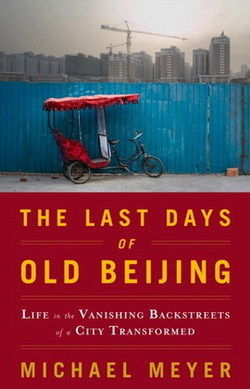
We were delighted to come across a piece by Friend of the Blog Michael Meyer (called "About That Book Advance...") in last week's New York Times Sunday Book Review section. We figured, based on the author's track record as a writer (and the insightfulness of his comments when talking about his work), that this piece would be lively and offer some illumination on an interesting topic and that it might also have some China tidbits. Well, it was not just illuminating (explaining how tough it can be for an author to live on what sounds at first like a very good advance, once the agent's cut and self-employment taxes come into play) but also entertaining (a favorite part: how in literary circles advance amounts are sometimes "coyly described like cigarette brands — the 'mid-fives,' the 'low sixes,' the 'mild sevens'").

But as for China tidbits... there were only two. We learned how much of an advance Meyer got for his book, The Last Days of Old Beijing (as in the spirit of disclosure he tells us precisely: $50,000), and even better we learned that his book will be coming out in paperback next month (take note all those in book groups, as it would work nicely in that setting). What kind of advance, you may be wondering, did we receive for China in 2008? Rather than tell you a number, let's just say it was in the "barely fours"--so barely that with just a dollar taken away, it would have been a three figure advance (albeit one of the "mighty threes"). Of course, Rowman & Littlefield basically doubled their up-front lay-out by giving each of our contributors a free copy.

After reading the piece, some of us had two thoughts. First, that academics trying their hand at writing for general audiences are lucky to have day jobs to cover the bills. And, second, that it would be nice if the New York Times Sunday Book Review section editors liked Meyer's essay as much as we did, in which case they might commission a sequel, in this case demystifying the high amounts paid for translation rights. A good starting point might be that famous $100,000 reportedly offered to bring out the English language version of a certain Cry of the Wild with Chinese characteristics, boy meet wolf tale that was criticized and celebrated by different China Beat contributors last year (and incidentally inadvertently helped China Beat earn its first mention in the New York Times' excellent "Paper Cuts" book blog).

**

As an addendum, we wanted to mention this upcoming event with Michael Meyer in New York:

The Last Days of Old Beijing - A Conversation with Author Michael Meyer
May 7th 6:30 - 8:00 pm New York Asia Society and Museum, Auditorium, 725 Park Avenue, New York
Cost: $7 students and members, $10 nonmembers

A longtime Beijing resident, Michael Meyer has, for the past two years, lived as no other Westerner – in a shared courtyard home in Beijing’s oldest neighborhood, Dazhalan, on one of its famed hutong (lanes). As Meyer describes in his book, residents' bonds are rapidly being torn by forced evictions as century-old houses and ways of life are increasingly destroyed to make way for shopping malls, the capital's first Wal-Mart, high-rise buildings, and widened streets for cars replacing bicycles.

Meyer will be joined in conversation with Orville Schell, Arthur Ross Director of the Center on US-China Relations at the Asia Society. Click on the above link for more information.

4/04/2009

China in 2008 Price Drop


Last Wednesday, Amazon dropped the price of China in 2008 to its lowest yet--just over $20 (the price has been fluctuating over the past couple weeks). And the site has also bundled China in 2008 with Peter Hessler's Oracle Bones for about $30, so if any River Town fans never got around to ordering the second book by one of our contributors, now would be a great time to do so.

Amazon's book bundling can be a little hit or miss, so we were wondering who Amazon would pair China in 2008 with, and were hoping it wasn't a book we'd criticized or felt uncomfortable being linked to. Suffice to say, we are delighted by what the web wizards came up with.

3/14/2009

Self-Promotion Saturday: Upcoming Events


A few reminders about upcoming events involving China Beat contributors.

Shanghai
Jeff Wasserstrom will be speaking about his new book, Global Shanghai, 1850-2010, at the Shanghai International Literary Festival tomorrow, March 15 at 4 p.m. City Weekend has been "live blogging" from the festival, so even those who don't attend can read transcripts from readings. Some highlights for Sinophiles: Stella Dong and James Fallows and Graham Earnshaw.

Hong Kong
Wasserstrom will also be presenting at the Man Hong Kong International Literary Festival on Tuesday, March 17 at 4 p.m. (at University of Hong Kong).

Charlottesville, VA
Susan Brownell and Kate Merkel-Hess will be on a panel at the Virginia Festival of the Book in Charlottesville on Friday, March 20 at 10 a.m. Brownell will be speaking about her recent book, Beijing's Games: What the Olympics Mean to China. Merkel-Hess will be speaking about the soon-to-be-released (on March 16) China in 2008 (to which Brownell also contributed).

3/07/2009

Self-Promotion Saturday: Conferencing in Shanghai


China Beatniks Jeff Wasserstrom and James Farrer and friend of the blog Andrew Field will be presenting this week at a March 12-14 conference at NYU in Shanghai (on the ECNU campus), called "Urban Representations." The conference is sponsored by NYU, Northwestern University, Sophia University, and ECNU. Click through for a schedule and paper titles.

2/21/2009

Self-Promotion Saturday


You can find a new interview with Jeff Wasserstrom at Shanghai City Weekend, in anticipation of the Shanghai International Literary Festival. You can find interviews with many other authors, including James Fallows and Cecelia Chang. There's also an interview with Wang Gang, the author of the very interesting-sounding novel English (about which CB was previously unaware). Here is a short excerpt from the interview with Wasserstrom (much more at City Weekend):
CW: What's one question you'd like to be asked at SILF? I'd love it if someone asked me: “If you could bring back to life, for a day, two people you've written about who are now dead, and ask them questions about what Shanghai was like then, who would they be and what would you ask them?”

CW: So who? I can't tell you my answer, it would take away the mystery!

CW: What made you want to record your YouTube video about Karl Marx? I haven’t actually recorded a video of the song you are referring to, which is called “Oh, Karl,” and which I have been known to sing to classes on occasion (in part to convince students that they need to keep coming to every lecture, since if they skip one they might miss something surprising).

CW: Can you “sing” us a few lines? Here’s the way it begins:
Let me tell you all a story of a friend of mine
Who’s known from Cuba to Lichtenstein
As the man who set the workers’ blood aflame
‘Cause he told about their exploitation
Increasing fragmentation
His name was “Marx” and dialectics were his game.
Ken Pomeranz has several up-coming events that readers in the Bay Area and Phillie may want to mark on the calendar.

First, on Friday, March 6, Pomeranz will speak on “Land Rights, Resources, and Chinese Development in Long-Run Perspective” for the Center for Chinese Studies at Berkeley.

Then, on Thursday, March 26, Pomeranz will address "Chinese Development and World History: Putting the 'East Asian Model' in Perspective" at the Department of History at Penn.

2/14/2009

For Book Lovers and China Enthusiasts…


Tis the season of book festivals, at least around here. A number of China Beat contributors will be speaking at events in the coming months. Here is a list of readings to add to your calendars:

1. The Man Hong Kong International Literary Festival. Scroll through their program to find panels with Xujun Eberlein (Saturday, March 14, 10 a.m., and again on Sunday, March 15, 3 p.m.) and Jeffrey Wasserstrom (Monday, March 16, 4 p.m. and 7:30 p.m. and Tuesday, March 17, 7:30 p.m.), as well as many other commentators and analysts (like Rebecca MacKinnon) and writers (like Zhu Wen) whose publications have been mentioned or linked to on China Beat.

2. The Shanghai International Literary Festival. Jeffrey Wasserstrom will be speaking Sunday, March 15, 4 p.m. Scroll through to find more friends of the blog on the program, including Stephen MacKinnon, Graham Earnshaw, and James Fallows. (Those interested in past visitors can scroll through the archives of Shanghai City Weekend's Book Club, which down near the bottom of the page has podcasts from the 2008 event available for downloading.)

3. Virginia Festival of the Book. Susan Brownell and Kate Merkel-Hess will be speaking at a panel on “Portraits of Contemporary China,” Friday, March 20, 10 a.m.

1/31/2009

Coming Distractions: The Annual AAS Meeting


Robert Buswell, Association for Asian Studies President, and Jeffrey Wasserstrom, the editor of the Journal of Asian Studies (and a China Beatnik, of course, who regularly contributes to this blog), have released a joint letter that may interest those who will be or are considering attending the AAS annual meeting in late March (or who simply like to follow the organizational goings-on of AAS and its flagship publications).

In the letter, Buswell, a U.C.L.A. specialist in Korean studies, and Wasserstrom lay out changes to this year's and future annual meetings, including efforts to expand the scope of the association to include diplomats, journalists, and public intellectuals as well as emphasizing disciplines not traditionally well-represented in the association (and speaking to issues that engage this broadened audience through topical essays in the JAS), and increasing the internationalization of the association's membership and journal coverage. To read the full contents, you can visit the AAS website.

For those who are interested in learning more about the schedule for this year's meeting in Chicago, March 26-29, the program is available online. The conference (where, incidentally, our by then-just out China in 2008 will be displayed in the book exhibit hall) will include keynote speeches by Christopher Hill, Assistant Secretary of State for East Asian and Pacific Affairs, and Han Sung-Joo, the former Minister of Foreign Affairs of the Republic of Korea and former Ambassador to the U.S. Journalists participating in panels at the conference include Howard French, Jonathan Fenby, Ching Ching Ni, Ted Fishman, and Nayan Chanda.

1/24/2009

Self-Promotion Saturday: Upcoming Events


There will be three China Beat contributors participating in an upcoming conference at the University of Southern California. On January 30, Jeffrey Wasserstrom, Susan Brownell, and Kate Merkel-Hess will all be speaking at the USC Center for Public Diplomacy’s conference, “The 2008 Beijing Olympics: Public Diplomacy Triumph or Public Relations Spectacle?” In part, our participation at USC is an outgrowth of the things we have been writing at China Beat this year, as well as the content of our forthcoming volume, China in 2008: A Year of Great Significance.

There are a lot of China-related events in Southern California these days. As proof, the USC conference will be held on the same day as a fascinating-looking event across town, enormously relevant to the “What Should Obama be Reading” feature that we’ve been running (and makes some of us wish we could be in two places at once). Also on January 30, the UCLA Center for Chinese Studies will be holding “Two Systems, One World: US-China Relations under the Obama Administration.” (Since none of us will be able to make it, please get in touch if you are attending and would be willing to blog about the proceedings for China Beat.)

The USC conference will be the first of several opportunities we’ll have this spring to talk about and promote China in 2008. Though we’ll mention these again when they get closer, there will be a number of the volume’s contributors on hand at the annual Association for Asian Studies meeting, one co-editor (Jeff Wasserstrom) will be speaking in March in Shanghai and Hong Kong, while another co-editor (Kate Merkel-Hess) and contributor Susan Brownell will be participating in the Virginia Festival of the Book in Charlottesville. In case you forget to mark your calendars, have no fear…we’ll mention it again!

1/03/2009

Global Shanghai's Futuristic Side


I'm writing this in 2008, but when you read it, the calendar will tell you it is 2009.  That wouldn't ordinarily be particularly noteworthy, since many blogs, including this one, alternate between running things just as they are written and scheduling them to appear a few days hence.  It just seemed relevant to mention because two pieces I've recently had go up online that are linked to and provide teasers for Global Shanghai, 1850-2010 deal with time and forward-looking issues.

One is the concluding segment of a Danwei.org two-parter on Shanghai and visions of the future.  This installment focuses on sci-fi writings with ties to that city, with passing nods to a couple of films, a fantasy poster that imagines Shanghai hosting a World's Fair in the 25th century, and the actual World's Fair set to take place there in 2010.  It has something to offer fans of Neal Stephenson and other cyberpunk authors.  But it also, perhaps less expectedly for at least some but not all readers of this blog, spends some time talking about a story written by the late Qing and Republican era intellectual heavyweight Liang Qichao, which has been analyzed insightfully by John Fitzgerald in a fascinating Thesis 11 article.

My other recent online Global Shanghai-related publication with a futuristic dimension was one I did for the wonderfully varied History News Network site.   Befitting an essay aimed more at historians and those interested in the past than China-focused readers per se, it explores the question of why someone belonging to the presumably backward-looking academic guild of which I am a member would include a date set in the future, 2010, in the title of a book.

There's a bit of other Global Shanghai news to report since my last SPS post, including two reviews I am very pleased with that can be accessed here and here. I've also got two other book teasers of a sort up on the web, each on sites I like a great deal.   One appeared on the Campaign for the American Reader website, as part of their "Page 99 Test" feature.  Their invitation to focus on that page gave me the challenge of reflecting anew about the chapter in the book dealing with the year 1975, which was in many ways the most difficult one for me to write.  The other was written for The Asia-Pacific Journal: Japan Focus.  I won't say anything more about that here, however, as China Beat will be running a post tomorrow (the tomorrow of this piece's publication, not the tomorrow of my writing these words) devoted exclusively to emphasizing how much interesting China-related material that venue, which originally concentrated more tightly on Japan, has been carrying.

12/20/2008

Divine Justice


By Paul Katz

As China ascends to its place as a leading nation on the world stage, questions have arisen concerning the role of its legal system. As Joseph Kahn noted in a feature article entitled Deep Flaws, and Little Justice, in China’s Court System, “Justice in China is swift but not sure.” Many protests in China today center on the issue of justice, with one blogger responding to the January 2008 fatal beating by parapolice officials of a man trying to videotape a protest by lamenting “Where is justice? Where is the law? Aren’t there any rules in China?

My newest book, Divine Justice: Religion and the Development of Chinese Legal Culture (Routledge 2008) considers these issues by examining the ways in which religious beliefs and practices have contributed to the formation of Chinese legal culture. It does so by describing two forms of overlap between religion and the law: the ideology of justice and the performance of judicial rituals.

The former covers beliefs about how the gods intervene in human affairs in this life and the next in order to ensure the attainment of justice. Because this ideal is rarely realized in earthly courts, many people place their faith in underworld deities who have the power to pass judgment on both the living and the dead.

The latter extends to the realm of practice, and involves instances when men and women perform oaths, chicken-beheadings, and underworld indictments in order to enhance the legitimacy of their positions, deal with cases of perceived injustice, and resolve disputes.

These rites coexist with other forms of legal practice, including private mediation and the courts, comprising a wide-ranging spectrum of practices that I refer to as the judicial continuum. Individuals ranging from high-ranking officials to chaste widows have performed judicial rituals for centuries, and such rites have shaped the legal histories of overseas Chinese in colonies like Batavia, the Straits Settlements, and Hong Kong, as well as those who immigrated to countries like Australia and the United States.

Despite the fact that China is experiencing a period of rapid religious revival, the fate of its judicial rituals is unclear, especially since religious beliefs and practices labeled as “superstition” (mixin 迷信) still face the very real threat of state persecution. Judicial rituals remain largely underground, meaning that the judicial continuum in China today remains fragmentary and inchoate. Inasmuch as the effective functioning of any legal system requires a certain degree of entirety, the extent to which the Chinese government proves willing to tolerate the performance of judicial rites may influence its citizens’ confidence in their ability to obtain true justice.

Penitents dressed as criminals process in front of a Hsinchu police station, with McDonald's sign in the background

In contrast, judicial rituals are an integral part of legitimation and dispute resolution processes in modern, high-tech nations like Taiwan, where people rely on such rites to deal with problems that are not readily addressed in the courtroom (particularly family tensions) or even resolve disputes that have already entered the formal legal system. The role of such rites in Taiwan’s current political environment remains to be seen, however, as its legal system faces many new challenges. The present state of affairs has prompted Amnesty International to issue a public statement urging the authorities to investigate concerns centering on charges of excessive use of police force, and to conduct legal procedures in a “fair, transparent, and timely manner in compliance with international standards.”

While some Taiwanese prosecutors have been quoted as asserting judicial authority by making statements such as “Suspects in certain cases investigated by prosecutors need not be convicted of a crime, but we can use [the legal process] to teach them a lesson” (檢察官辦案不一定是要當事人被判有罪,但至少要讓他們得到『教訓』), it might be worth bearing in mind the late Attorney General Robert Jackson (1892-1954)’s definition of what it takes to be a distinguished prosecutor: “The citizens’ safety lies in [someone who] tempers zeal with human kindness, who seeks truth and not victims, [and] who serves the law and not factional purposes.”

12/06/2008

Global Shanghai News


Regular readers of this blog may think it is a bit redundant for me to do a "Self-promotion Saturday" post about Global Shanghai, 1850-2010: A History in Fragments, since I've managed to slip references to and images of the cover of my new book onto the site already in recent a piece about the 1980s and one about the Beijing Forum, cell phones, and a Chinese Obama joke.

Still, when you've worked on a publication as long as I labored on this one (even though it is a short, it took well over a decade to get from first inspiration and initial research to actually having the first copies in hand this week), the actual appearance of the artifact is something you want to mark. (The book should be available for purchase in Britain now, ready for sale in other parts of the world early in the new year.)

I also couldn't resist the opportunity to mention the first review it has received, a very positive one in That's Shanghai, which not only has just the kinds of adjectives authors love to find applied to their books but is written with verve to boot. And who wouldn't like getting five out of five thumbs up?

In addition, just in case there are any China Beat readers who don't also regularly check out the Danwei site as well, this post gives me a chance to pass on the word that I have a new piece up there linked to the book. It's the first of a two-part essay called "A Brief History of Shanghai's Future" (the sequel will follow soon). It isn't an excerpt per se, but it draws from material in Global Shanghai and should give readers a pretty good sense of what the book is like.

Other pieces that tie-in with the book will be published elsewhere on the web. I'll flag them in future posts. I'll also use those posts as an opportunity to give some background on the book (like why a historian like me has a year still to come in its title) and mention places I'll be giving book-related talks. So stay tuned.

11/29/2008

China in 2008: Pre-Orders Now Available


The weekend after Thanksgiving is the beginning of the Christmas shopping season, but if you'd like to avoid the crush at the malls, China in 2008 now has its own webpage, where you can order a copy for all those hard-to-gift friends (especially if they don't mind it arriving in March--the release date for the book...).

11/22/2008

Peng Mulan in China


As part of our continuing follow-up on "China Beatniks in Beijing," we wanted to share with you a couple links to articles on the talk Kenneth Pomeranz (彭慕兰) gave at Qinghua University, here and here (both in Chinese). Pomeranz's talk for the Beijing Forum was at Diaoyutai State Guesthouse, the site of Nixon and Mao's meeting as well as the former home of Jiang Qing. Here are few pictures:


The outside of Diaoyutai


Ken Pomeranz speaking at the Beijing Forum

11/08/2008

China in 2008: Cover Art


One of the themes in our forthcoming book, China in 2008: A Year of Great Significance, is how the year 2008 came to symbolize more than just the hosting of the Olympics in China. "2008" came to mean China's emergence on the world stage with the respect and admiration of people around the globe. When we saw this picture, taken by Shanghai-based photographer Iain Harral, it seemed to represent that fervent hope--so fervent that it was, in this case, literally written on the body. We're grateful to Iain for allowing us to use this photo on the cover of our forthcoming book. Once we have a final cover mock-up, we'll be sharing that here. In the meantime, we wanted to give you a peek at Iain's fabulous image.

11/01/2008

China in 2008: What's Inside


While our forthcoming blog-to-book, China in 2008, contains some content that regular China Beat readers will find familiar because versions of the pieces have either run or been linked to at China Beat (though many of these have been expanded or revised also), about one-third of the book is brand-new. Below, find the table of contents listing the essays included in the book's fifteen chapters. Each chapter also includes additional, brief excerpts from the blog which are not listed here. China in 2008 will be published in early 2009.

Introduction
China in 2008: A Reflection on a Year of Great Significance, by Kate Merkel-Hess

Chapter 1: Anxieties of a Prosperous Age
NIMBY Comes to China, by Jeffrey N. Wasserstrom
Homeowners’ Protests in Shanghai: An Interview with Benjamin Read, by Angilee Shah
Gilded Age, Gilded Cage, by Leslie T. Chang
Melamine and Milk in Modern China, by Anna Greenspan
Little Emperors or Frail Pragmatists? China’s ’80ers Generation, by Yunxiang Yan

Chapter 2: Tibet
At War with the Utopia of Modernity, by Pankaj Mishra
How to Think About Tibet, by Donald S. Lopez, Jr.
Ballooning Unrest: Tibet, State Violence and the Incredible Lightness of Knowledge, by Charlene Makley

Chapter 3: Meanwhile, Across the Straits…
Readings on Taiwan, by Paul R. Katz

Chapter 4, Nationalism and the Torch
Torching the Relay: An Interview with Geremie Barmé, with questions from Woroni
Chinese protesters extinguish Olympic torch in protest?, from Danwei.org
Why Were Chinese People so Angry about the Attempts to Seize the Torch in the International Torch Relay?, by Susan Brownell

Chapter 5, Earthquake and Recovery
Rumor and the Sichuan Earthquake, by S. A. Smith
Earthquake and the Imperatives of Chinese Mourning, by Donald S. Sutton
Chinese Responses to Disaster: A View from the Qing, by Kathryn Edgerton-Tarpley
China and the Red Cross, by Caroline Reeves
Resistance Is Useful, by Rana Mitter
After the Earthquake: Former students report on the disaster, by Peter Hessler
Letters from Sichuan II, by Peter Hessler

Chapter 6, Shanghai Images in Beijing’s Year
Disappearing Shanghai, by Howard W. French

Chapter 7, Tiananmen Reconsidered
Tiananmen’s Shifting Legacy, by Jeffrey N. Wasserstrom
The Gate of Heavenly Peace-Making, by Pär K. Cassel

Chapter 8, The Road to the Olympics
China’s Olympic Road, by Susan Brownell
The Boycotts of ’08 Revisited, by Jeffrey N. Wasserstrom
How to Talk to Strangers: Beijing's Advice, by Mary S. Erbaugh
Learning English, Learning Chinese, by David L. Porter

Chapter 9, The Olympics as Spectacle
It’s Right to Party, en Masse, by Haiyan Lee
Where Were China’s Women on 08/08/08?, by Nicole E. Barnes
What Would Mao Think of the Games?, by Jeffrey N. Wasserstrom
The Olympics Around the World, excerpts by Pierre Fuller, David Luesink, Miri Kim, Paola Voci, and Shakhar Rahav
From Lovers to Volunteers: China’s National Anthem, by Liang Luo
Beijing's Olympic Weather: “Haze,” Blue Skies, and Hot Air, by Alex Pasternack
Beijing’s Olympic Soundscape: Volunteerism, internationalism, heroism and patriotism at the 2008 Games, by Daniel Beekman

Chapter 10, China after the Games
One Bed, Different Dreams: The Beijing Olympics as seen in Tokyo, by James Farrer
China’s Olympic Run, by Pallavi Aiyar

Chapter 11, Follow the Leader
Facing Up to Friendship, by Geremie R. Barmé
Preserving the Premier’s Calligraphy at Beichuan Middle School, by Richard C. Kraus
Boss Hu and the Press, by Nicolai Volland
Hua Guofeng: Remembering a Forgotten Leader, by Jeremiah Jenne

Chapter 12, Things Seen and Unseen
Digital China: Ten Things Worth Knowing about the Chinese Internet, by Kate Merkel-Hess and Jeffrey N. Wasserstrom
The Chinese Press in the Spotlight, by Timothy B. Weston
Finding Trust Online: Tigergate to the Sichuan Earthquakes, by Guobin Yang
Things We'd Rather You Not Say on the Web, Or Anywhere Else, by David Bandurski

Chapter 13, Pop Culture in a Global Age
Kung Fu Panda, Go Home!, by Haiyan Lee
In Defense of Jiang Rong’s Wolf Totem, by Timothy B. Weston
Wolf Totem: Romanticized Essentialization, by Nicole E. Barnes
Wei Cheng: From an Elite Novel to a Popular Metaphor, by Xia Shi
Faking Heaven: It’s All Done with Mirrors, by Timothy S. Oakes

Chapter 14, Reinvented Traditions
The Global Rebranding of Confucius, by Julia K. Murray
China: Democracy, or Confucianism?, by Xujun Eberlein

Chapter 15, China and the U.S.
A Nation of Outlaws, by Stephen Mihm
Democracy or Bust: Why our Knowledge about What the Chinese Lack is Really No Knowledge at All, by David L. Porter
Follow the Money: A Tale of Two Economies, by Kenneth L. Pomeranz
Yellow Peril Consumerism: China, North America, and an Era of Global Trade, by Amy Hanser

Afterword by Kenneth L. Pomeranz

10/18/2008

China in 2008: A Year of Great Significance


Last month, we announced our forthcoming book, China in 2008: A Year of Great Significance, to be published by Rowman & Littlefield in early 2009. With the manuscript beginning to take its final shape (and 2008 far enough advanced that we felt somewhat—but only somewhat, given what a crazy year it's been so far—safe beginning to reflect on it), we thought we would share a little bit from the book with you. In the coming weeks, we hope to share with you a preview of the table of contents as well as perhaps snippets of other new pieces from the book.

For today, here is a short selection from the introduction to the book, “China in 2008: A Reflection on a Year of Great Significance,” by Kate Merkel-Hess:

The subtitle of this volume is a play on Ray Huang’s groundbreaking Ming history, 1587: A Year of No Significance. In that book, Huang examined a year of no particular importance when the Emperor Wanli was in power. The irony of Huang’s title is that Wanli’s disastrous reign was the beginning of the end for the Ming Dynasty (1368-1644), which fell to internal rebellions and then the Manchu invasions that led to the establishment of the Qing Dynasty (1644-1911), China’s last. Fifteen eighty-seven matters a great deal because, while it was not a year of important events, it was apparent in its day-to-day affairs that the Ming was headed toward ruin.

This year, in contrast, was a year of important event after important event for China. In fact, the year was an enormously important year globally, both for stories that pointed the way toward a new world order (geopolitically and financially) and stories that seemed resurrected from news cycles past. In the early panicked days of the fall’s economic woes, coming amidst the U.S. presidential campaign as well as several other big domestic and international stories, David Folkenflik commented on National Public Radio (NPR) that “the breakneck pace of developments means a lot of news worth knowing receives the briefest burst of attention before being dropped for something hotter.” China’s tainted milk story was overshadowed by the U.S. presidential election and the escalating credit crisis. Russia’s invasion of Georgia coincided with the highly-anticipated Olympic Opening Ceremony. The riots in Tibet and the contentious U.S. Democratic primaries pushed rising international food prices off the front pages.

China’s presence in many international stories, from the banking crisis to the genocide in Darfur, was further evidence of its role as an emerging superpower. Just as Russia did for previous generations, China raises the specter for Americans of a functioning superpower with a markedly different economic system as well as a divergent set of political assumptions (several contributors explore the results of these fears in Chapter 15). In July, New York Times columnist Thomas Friedman wrote about the Chinese (and Russian) vetoes of U.N. attempts to impose sanctions on Robert Mugabe, President of Zimbabwe. The votes, Friedman asserted, show us where the world is headed: “a world of too much Russian and Chinese power.” Some China fear-mongers went further than the moderate Friedman, talking about “the coming China wars.” But the fact was, the China stories of 2008, taken together, sketch a picture of a China not on the verge of destruction, as in 1587, or a nation spoiling for a fight with the international community, but instead a relatively stable country, focused above all else on trying to maintain its phenomenal 10 percent economic growth rate.

This may seem an incongruous assertion, as other than the relatively smooth two weeks of China’s triumphant Beijing Olympics, when China was in the international news in 2008 it was at moments of crisis: crippling winter storms hit the country in late January, riots occurred throughout Tibet and other parts of southwest China in March, international protests accompanied the spring’s Olympic torch relay, a devastating earthquake rocked Sichuan in May, a massive food safety scandal broke in September, and in October a plummeting stock market hit the Shanghai and Hong Kong as well as New York, London and Tokyo exchanges. Instead of a year of Olympic celebration, for the Chinese people 2008 was the most tumultuous and traumatic year of the post-1978 economic reform era. Unlike 1587, however, we cannot discern in China’s day-to-day life signs of impending doom. Business as usual looks pretty good: the economy continues to grow and consumers continue to spend, China continues to increase international engagements, and all signs point to continued (if incremental) increases in citizen participation in government affairs…

9/19/2008

Blog to Book: The China Beat Moves into the Print World


This Self-Promotion Saturday will be the first of a series devoted to a book project: China in 2008: A Year of Great Significance. Rowman & Littlefield will be publishing it fairly early in 2009 and it will be edited by three people familiar to "China Beat" readers: Kate Merkel-Hess, Ken Pomeranz and Jeff Wasserstrom, all of whom are based at UC Irvine. Some of the content will also be familiar to "China Beat" readers, since the book will include material that first appeared on this site (though in some cases in an updated and expanded form). China in 2008 will also contain pieces that first appeared in other digital or print publications, as well as completely new things, created just for the book.

Books that evolve out of blogs are still a relative rarity in the American publishing world, though there have been some notable success stories, from Julie to Julia: 365 Days, 524 Recipes, 1 Tiny Apartment Kitchen to Stuff White People Like. But as many followers of the "China Beat" know, they are more common in China, where sometimes several of the top selling books at a particular moment are tied in some way to blogs, sometimes made up of nothing but the posts that appeared on one.

Our taking "China Beat" off-line, while keeping it going on-line, of course, is an experiment, and we'll be filling you in periodically on how it is going. We'll probably talk in future about challenges we face, from meeting tight deadlines to maintaining the loose feel of a blog while creating something that can be carried around, assigned in classes, and we hope picked up at the airport by some people who have never visited the site but think China in 2008 looks like good reading material on their first flight to Beijing, Shanghai or Hong Kong. We'll also have things to say about how the volume is shaping up, and maybe provide some teasers about the new material.

Our main message for now is simple: stay tuned. And if anyone else out there is thinking that 2008 has been such an eventful year so far that a play on the title of 1587: A Year of No Significance is in order, we've laid a claim to that idea in the subtitle (though we'd be happy to include a tip of the hat in our acknowledgments page to anyone who has beat us to the punch in a web posting or op-ed).